
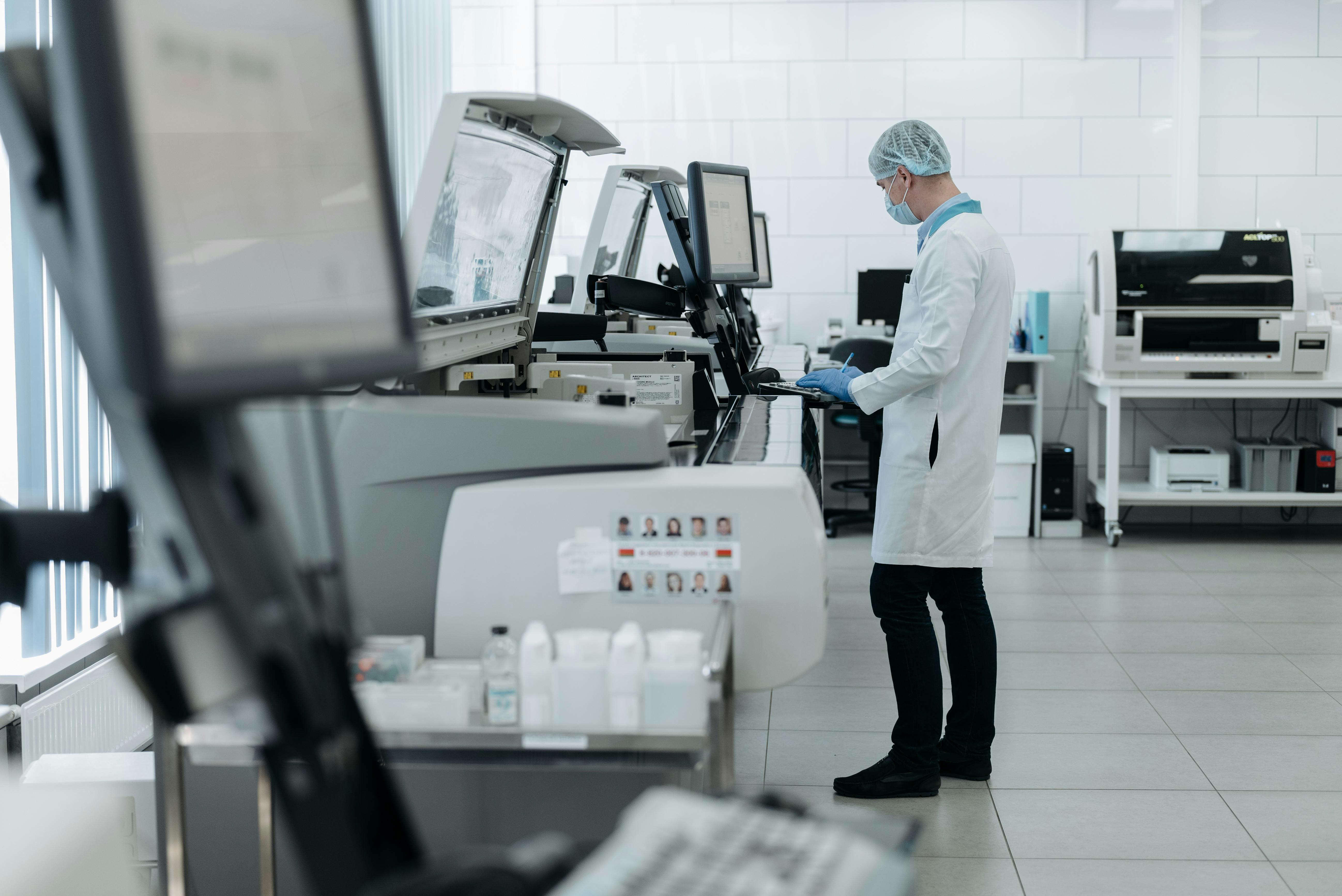
The mainstream AI-in-pharma story has been the same one for about three years now. A startup announces a drug candidate identified in eighteen months instead of four years. The cycle time gets cited. The accompanying photo is usually a researcher in a white coat looking at a screen. And the implicit message is that AI is going to compress drug discovery the way it compressed software development.
The drug discovery story is real, but it isn’t the most interesting thing happening in biopharma right now. The more consequential shift is that AI analytics have moved out of the discovery silo and into clinical operations, manufacturing, and commercial. Three completely different parts of the business, with three different sets of stakeholders, three different ROI profiles, and three very different regulatory exposures. The combined effect is what’s reorganizing the industry, not the individual headlines about any one molecule.
What’s working in discovery (and what isn’t)
Start with discovery, because that’s where the public narrative lives. The numbers are real. Insilico Medicine averages 12 to 18 months per program, testing 60 to 200 molecules. Exscientia, before merging with Recursion, claimed to have shortened timelines from four or five years to 12 to 18 months while screening only 150 to 250 molecules compared to traditional methods that sometimes require testing 3,000 to 5,000. Insilico’s lead candidate ISM001-055 (now rentosertib) for idiopathic pulmonary fibrosis produced positive Phase 2a results published in Nature Medicine in June 2025, which is the closest thing to peer-reviewed clinical validation the AI-first discovery thesis has produced to date.
The counter-story is also worth taking seriously. Recursion discontinued REC-994 for cerebral cavernous malformation in May 2025 after long-term data failed to confirm earlier trends, described in some industry coverage as the most significant single failure in the AI-first drug discovery field’s recent history. Several months after the Exscientia merger, Recursion further deprioritized three clinical-stage programs and paused another. The original promise of ten near-term clinical readouts hasn’t materialized on the timeline the merger announcement suggested.
The honest read is that AI is making discovery faster, but biology is still biology. About 90% of compounds entering Phase 1 trials fail before approval, regardless of how they were discovered, and AI-discovered compounds are not immune to that base rate. The cycle-time compression is real, the molecular productivity is real, the late-stage clinical translation is still hard. Dr. Paul Agapow, formerly Director of Data Science at GSK, put it about as cleanly as anyone has: “We’ve bent the curve, but we haven’t achieved the slam dunk people were hoping for.”
That framing matters because it sets up the rest of the picture. The places where AI analytics are clearly working today are upstream of the late-stage trial problem and downstream of it. The middle, where biology gets a vote, is harder.
Clinical operations is where the leverage shows up
The clinical side is where most of the real ROI from AI analytics in biopharma is being captured right now, and it’s significantly underreported relative to the discovery hype. The mechanics are less photogenic. There’s no novel molecule. There’s just the slow, expensive, error-prone work of running a trial, and AI is making most of those line items meaningfully cheaper or faster.
Patient recruitment, traditionally the largest single source of trial delays, is being transformed by tools like TrialGPT and TrialMatchAI that match patients to trials by parsing electronic health records at scale rather than relying on manual chart reviews. Industry analysis suggests AI-optimized operational execution across site selection, recruitment, and regulatory submission preparation can collectively shave up to 14 months off a conventional development timeline. Fourteen months on a development program that previously ran six to eight years is meaningful in a way that no single discovery shortcut is, because it compresses the entire revenue timeline rather than just the front end.
Synthetic control arms are starting to show up in real regulatory submissions. Companies like Unlearn are using synthetic control arms to reduce patient burden and costs in Alzheimer’s trials, where recruitment is structurally difficult and ethical concerns about placebo arms are acute. The caveat is that regulators remain skeptical of pure in silico approaches because they rely on synthetic patients rather than observed clinical outcomes. The current accepted use is hybrid, augmenting real control arms rather than replacing them.
The regulatory layer has moved noticeably in the past four months. In January 2026, the FDA and EMA jointly published Guiding Principles of Good AI Practice in Drug Development, a set of 10 high-level principles intended to align international expectations for AI used across the drug life cycle. In April 2026, the FDA opened a request for information on an AI-Enabled Optimization of Early-Phase Clinical Trials Pilot Program, explicitly targeting patient recruitment, dose escalation, safety monitoring, adaptive trial designs, and Phase 1 to 2 decision-making. AstraZeneca and Amgen are already running early-phase trials feeding into this real-time monitoring framework, with AstraZeneca’s Phase 2 lymphoma combination therapy at MD Anderson and UPenn, and Amgen’s Phase 1b small cell lung carcinoma program both running on a real-time data platform built by Paradigm Health.
This regulatory shift is doing two things at once. It’s lowering the perceived compliance risk of using AI in trials, which makes more conservative sponsors comfortable adopting it. And it’s establishing what “good AI practice” means before any single vendor or sponsor gets to define it through precedent. The companies that aligned their internal AI governance frameworks early are going to have an easier time with the next round of approvals than the ones still waiting to see how the rules shake out.

Manufacturing is the unsung adoption story
The third place AI analytics are getting real traction is manufacturing, and it’s the one part of the picture that gets almost no coverage in the mainstream AI-in-pharma narrative. More than 60% of major pharmaceutical companies are now using AI to revolutionize manufacturing processes, with the typical use cases being real-time process monitoring, automated quality inspections, predictive maintenance, and supply chain optimization.
The named examples are worth sitting with because they’re not pilots. Sanofi applies AI to enhance production yield and process effectiveness. Novartis uses machine learning for real-time plant monitoring and supply chain optimization. Merck uses AI to reduce false reject rates in quality assessments. Moderna leverages AI-based tools for quality control systems. Pfizer’s engineering team used computational fluid dynamics to create digital twin models of stirred-tank bioreactors, virtually running thousands of “what-if” scenarios to reduce time-to-scale by months and increase first-pass success rates on physical pilot runs.
The reported ROI is reasonably consistent across pilot programs in the space. A documented AI predictive maintenance implementation at a pharmaceutical manufacturer produced a 25 to 30% reduction in unplanned downtime via real-time monitoring of pumps, HVAC systems, and other critical assets. The pattern across other pilot data is fewer rejected batches and faster process scale-up. None of those are headline-grabbing on their own. Aggregated across a multinational manufacturing footprint, they add up to a meaningful margin improvement.
Why does this matter strategically? Manufacturing AI is the place in biopharma where the ROI is most predictable, the regulatory exposure is lowest, and the data infrastructure is best understood. It’s the part of the AI portfolio that funds the rest of the AI portfolio. BioSpace’s coverage of Pfizer’s Q4 2025 earnings call noted that Pfizer’s CFO Dave Denton credited AI deployment across the business with driving cost realignment savings being redirected into R&D programs, which is the opposite of the public narrative that has AI cost centers concentrated in discovery.
How the stack composes
The companies pulling ahead in biopharma are not the ones with the splashiest discovery announcements, they’re the ones treating these three layers as a single integrated stack. Pfizer is the cleanest example. Klover.ai’s analysis of Pfizer’s strategy frames it as a “common thread of AI and data” running through discovery, development, manufacturing, and commercialization simultaneously, rather than as a series of vertical pilots. Eli Lilly is making a similar bet, announcing in January 2026 a co-innovation lab with Nvidia that includes the BioNeMo platform, Lilly’s DGX SuperPOD, an agentic lab system, and a total investment of up to $1 billion over five years across talent, infrastructure, and compute.
The reason integration matters is that the value isn’t really in any individual layer. The discovery savings are real but absorbed by clinical failure rates. The clinical savings are real but partially offset by regulatory friction. The manufacturing savings are real and durable. When the three layers feed each other (a discovery hit informs a more efficient trial design, trial telemetry informs manufacturing process design, manufacturing data informs the next discovery round), the compounding effect is what produces a structural advantage. Most companies are still running the layers as separate budgets with separate vendors.
There’s a corollary worth being explicit about. The benchmark numbers on agentic AI systems specifically remain sobering. Stanford’s MedAgentBench evaluation, published in the New England Journal of Medicine AI, found that the best-performing AI agent completed only 36.3% of full clinical tasks successfully in a virtual EHR environment, even though the same systems hit 82.8% on individual subtasks. That gap between subtask competence and end-to-end task completion is the kind of stat that should temper any “AI agents are reshaping drug development” framing. The systems are useful for narrowly defined analytical workflows. They’re not yet generalist scientific reasoners, even in the most well-funded labs.
What this means for everyone else
The implication for biopharma leaders outside the top dozen integrated players is that the playbook isn’t to chase the discovery story. The playbook is to look at the clinical and manufacturing layers, where the ROI is more predictable, the regulatory pathway is clearer, and the data infrastructure already exists. Most mid-tier pharma and most biotechs are still under-investing in AI on the operational side relative to the discovery side, in part because the operational side is less interesting to talk about at conferences.
The other implication is for the vendors and partners selling into this market. The biopharma AI landscape has gotten genuinely crowded, with overlapping offerings across patient recruitment, trial monitoring, real-world evidence, manufacturing analytics, and discovery. The buyers that are getting value out of it are the ones who built the stack thoughtfully, with partners who understand the regulatory and operational context and not just the underlying models. The buyers who got sold a platform and went looking for use cases afterwards are mostly still where they started a year ago.
The discovery headlines will continue. The Insilico Phase 2a result was real, Lilly’s billion-dollar Nvidia investment is real, and at some point a fully AI-discovered drug is going to land an approval that gets framed as a vindication of the original thesis. But that approval, when it happens, will be a single data point in a much larger reorganization that’s already mostly done by the time the press release goes out.

 →
→