
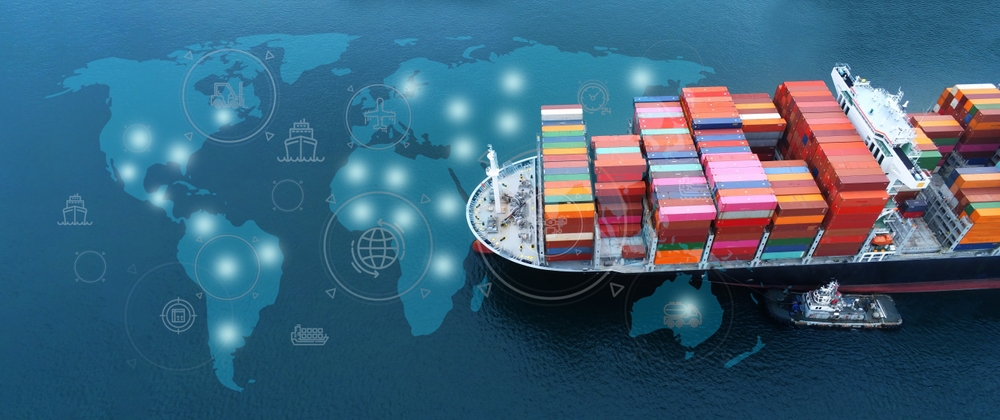
With the supply chain crises of the past five years, manufacturers could be forgiven for feeling a bit like a worn-out punching bag. From COVID-19 closing factories, to a container ship wedged in the Suez Canal, a global semiconductor deficit that shut down automotive assembly lines. Now, war in Iran and spiking oil prices. The future looks grim.
Companies were operating supply chains designed for a world where disruptions were local and recoverable. But the last half-decade has felt like an endless string of globally disruptive events that even the most powerful enterprises in the world find difficult to plan for.
That is a problem AI now helping solve, and nowhere but in logistics are the results are most evident.
Why Supply Chain Led the Way on AI
Most enterprise AI deployments face a few common challenges: data quality problems, model interpretability, change management friction. Supply chain and logistics avoided much of these stallers because the environments setup were already structured to solve them.
Orders, shipment tracking, ERP inputs, carrier schedules, customs records have all been mostly digitized, with timestamps and transaction logs. Unlike manufacturing shop floors, where cutting conditions shift by the second and sensor data is noisy, warehouses and freight networks deal in clearer and more predictable information environments. The tasks are well defined (move a pallet, ship a container, reorder a SKU, etc…) which makes it ideal territory for machine learning.
That environment is primed for ML algorithms to observe patterns, optimize decisions, and improve over time. Warehouses have been proving this for years. The shift now is that the same capability is moving up the stack, from individual distribution centers to the entire supply network.
What Machine Learning Is Doing
There are two key places where ML is helping solve the crisis-driven crises in logistics.
Demand forecasting. Traditional forecasting relied on historical averages, seasonal adjustments, and experienced planners reading the room. That approach fails when demand shifts faster than the review cycle. An AI-driven forecasting system integrated into ERP data can generate daily SKU-level predictions across sales channels, flagging changes before they become stockouts, and providing lower inventory carrying costs and higher service levels.
Supply chain scenario modelling. This is the capability that the disruption events of the last five years made urgent. AI scenario models ingest data from internal systems (ERP, inventory, transport schedules) alongside external signals (weather forecasts, shipping delay data, raw material prices, geopolitical signals) to simulate disruptions before they fully materialize. When a supplier in a high-risk region reports a labour shortage, the model predicts which products will be affected, estimates when delays will reach the final customer, and surfaces alternative sourcing options. Prescriptive suggestions let the procurement team reroute orders and adjust production with minimal disruption. That is a meaningful shift: from reacting to disruptions after they happen, to modelling them in advance and building a playbook.
These capabilities share a design principle. The AI is giving logistics managers the information they could not otherwise have, at a speed that makes it actionable. Managers are still making the final call on strategic sourcing or production adjustments, but now there is a generational leap in the quality of the information in front of them and the time available to them to act.
The Canadian Track Record
The National Research Council of Canada’s AI for Logistics program has been quietly producing results since 2019, funded through Canada’s AI Global Innovation Cluster Scale AI and the Government of Canada. The program brought together NRC researchers, university scientists, and Canadian industry partners to apply AI to real-world freight and logistics problems.
The results from that collaboration tell a specific story about what AI can do when it is tested against actual operational data rather than benchmark datasets.
Working with the City of Calgary, researchers from the NRC and the University of Calgary built AI-driven routing tools using deep learning models trained on real traffic and weather data. Tests showed the system can improve travel time by 14% and vehicle speed by 13% while reducing CO2 emissions by 4%. Those numbers are not hypothetical projections. They reflect performance on observed data from Calgary’s actual freight network.
Canada Cartage, one of the country’s largest transportation and logistics companies, partnered with the research team to tackle regional network optimization. Their goal was to reduce total travelling distance and the number of vehicles required to serve their routes. The proposed AI solution, trained on Canada Cartage’s own industrial data, reduced total distance travelled by about 19% and the number of vehicles needed by 24%.
Bison Transport, which operates more than 3,000 tractors and 10,000 trailers across North America, faced a different problem: a mixed fleet serving both scheduled and ad hoc freight, which requires repositioning equipment on short notice. Preliminary findings showed the NRC-developed routing system could cut potential wait times for unscheduled customers by more than 33%.
“This partnership provides researchers with real-world logistics data to help us understand each industry client’s unique problems,” said Dr. Yunli Wang, Senior Research Officer at the NRC’s Digital Technologies Research Centre. “We can then develop practical solutions and training programs that benefit not only them but also the Canadian economy.”
The program has also delivered on workforce development, training over 119 students and postdoctoral fellows in applied AI for logistics. That matters because the skills gap in this domain is a genuine constraint.
“Collaborating with us enables companies to leverage cutting-edge AI technologies, optimizing their planning tools,” said Dr. Xin Wang, University of Calgary professor and NRC lead investigator. “At the same time, our projects provide students with valuable real-world application experience, ensuring they enter the Canadian job market well prepared.”
The broader framing from the program leadership is worth taking seriously. NRC program lead Margaret McKay has noted that these tools can be extended and adapted to any city and scenario, and that wider deployment would compound the gains significantly.
“The more of Canada’s geography that these tools see, the better they can serve everyone. This is good for companies, citizens and the environment. Let’s keep working together to make supply chain and logistics excellence a competitive advantage for Canada.”
Digital Twins and the Factory-to-Freight Connection
One of the more significant shifts in how manufacturers are thinking about supply chain AI is the move toward digital twin technology at the network level. A digital twin of a supply chain is a virtual model of the entire operation, including suppliers, production facilities, distribution centers, and last-mile carriers, that updates continuously from live data. It allows manufacturers to simulate disruptions and resource shortages in real time before they impact production.
This matters because the alternative is playing catch-up. Without a live model of the supply network, a disruption in one node is invisible until its effects propagate downstream. By that point, the options available to the procurement team are constrained, time is short, and decisions get made reactively under pressure.
Digital twin technology also connects supply chain AI to the broader smart manufacturing context. When an AI system can see both the factory floor and the inbound logistics network simultaneously, it can optimize across both. A production slowdown in one facility can automatically trigger scenario analysis for alternate sourcing and rerouting. A surge in demand from a major customer does not wait for next week’s S&OP meeting. The system flags it, and the relevant teams get the information they need to act.
The Challenges That Slow Deployment
Supply chain AI faces three categories of friction that organizations consistently underestimate.
Data integration. Supply chains are assembled over decades from systems that were never designed to talk to each other. ERP systems, warehouse management platforms, carrier tracking tools, and customs databases all hold relevant data, and most of it sits in silos. Feeding an AI model with siloed data produces siloed predictions. Getting the integration right before deploying a model is not exciting work, but organizations that skip it tend to get poor results and conclude that the technology does not work. In many cases, the data infrastructure was the bottleneck, not the model.
Interpretability and trust. Supply chain decisions can involve millions of dollars of inventory and commitments to major customers. Planners who are told “the model recommends delaying this purchase order” and cannot see why are unlikely to act on that recommendation. The best-designed deployments include explainability features that show planners the signals driving a prediction: which supplier risk flags, which demand indicators, which inventory thresholds tipped the recommendation. That transparency builds the trust that makes the model’s outputs actually useful.
Change management. Virtually every organization that has deployed AI in supply chain has encountered resistance from planners who see the technology as a threat to their institutional knowledge and their jobs. That resistance is understandable. In most cases, the more honest framing is that AI handles the high-volume, repeatable prediction work that consumes much of the planner’s time, freeing them to focus on the judgment calls, the supplier relationships, and the edge cases that models handle poorly. That reframing takes deliberate effort and clear communication to land.
IBM has noted that virtually all organizations surveyed expect AI and automation to affect their operations in some significant way. The challenge is not whether the change is coming. It is whether the workforce is being prepared for it.
Where the Attention Should Be Now
The supply chain disruptions of the past five years have made the case for AI investment at the executive level. The question most organizations are now working through is sequencing: where to start, and how to build from an initial deployment toward a genuinely connected supply network.
The practical entry points are consistent across organizations that have seen early success. Start with forecasting, because the data exists, the baseline is easy to measure, and improvement is easy to demonstrate. Build confidence in the model’s outputs before expanding its scope. Move from demand forecasting to inventory optimization once the data infrastructure is in place. Introduce scenario modelling once there is organizational readiness to act on what the model surfaces.
The underlying logic is the same one that drives successful AI deployments in any domain. The model’s value comes from the system around it. Data pipelines, human-in-the-loop design, clear escalation paths when predictions conflict with planner judgment, and auditability at the decision level. None of that is as interesting as the headline capability. All of it is what makes the headline capability actually work.
Supply chain AI is not a futuristic concept being piloted in research labs. It is running in production at large Canadian freight companies and at health systems, food manufacturers, and automotive assemblers around the world. The organizations that treat it as infrastructure rather than innovation theatre are already compounding the gains.
The ones waiting for a cleaner moment to start are compounding the gap instead.

 →
→